


Jeddah Corniche
Book restaurant now with Jeddah waterfront website
UX Research & Design Project

The challenge:
We were assigned as a team of four to work on Jeddah Corniche experience in order to boost tourism. Our goal was to design a responsive website for Jeddah corniche that fits the needs of both national and international tourists. My role was as a Product Manager. The rest of the team was made of a visual designer, information architect, and user researcher.
The duration of the project:
Two weeks.
Methods and the tools used:
Method: Double Diamond (User Experience Process).
Tools: Figma, Miro, Survey Monkey, Sticky Notes, Pen and Paper.
Our first challenge was defining a real problem to solve:
The discover steps included:
-
User Interviews were taken by 7 visitors of Jeddah corniche.
-
Survey Analysis were answered by 36 visitors most of whom were satisfied females between the age of 21 to 30. Jeddah Waterfront, clean? Yes. Visitors stayed at least one hour, ate one meal and paid less than 50 SAR. One popular comments are the need for bikes rentals and a food court.
-
Contextual Inquiry were answered by 4 families, 13 users, When we conducted a Contextual inquiry on Jeddah Waterfront, We observed people between the Pearl Yard and Sand Yard We observed 4 families who have 3 members at least, Most of what we saw is a mothers with their children, 2 of families are tourists who visit the Jeddah Waterfront for the first time.
Research Findings:
-
Indicators for available parking spots are missing.
-
No food providers.
-
Know the Map system.
-
Know the reporting system.
Lightning Decision Jam:
focused on three key problems and identify possible solutions.
_edited.jpg)
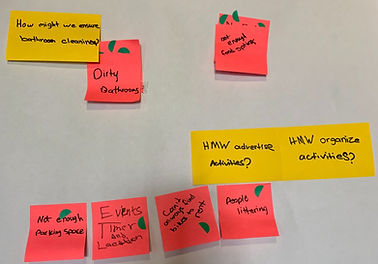
This map has the main problems that faced visitors such as Parking, Events, Food options, Dirty bathrooms, And Bikes availability.
_edited.jpg)
In this map we focus on increasing food options.
_edited.jpg)
In this map we focus on activities for adults because most of them are for kids.
_edited.jpg)
On this map we focus on ensuring the cleanliness of the Jeddah Waterfront

This is the last map where we show the Impact to Effort ratio, top left is the higher impact less effort.
Design Hypothesis:
.jpg)
And here is the first challenge I faced while working which is trying to define the real problem and properly solve it.
The second step was I defined the Persona:
Methods and the tools used:

What is the problem?
It was about Sally she wishes to have lunch on Friday with her family. Also, She wants to have more food options for her family to enjoy during their weekly gathering at the corniche because she wants to have options to cater for all the different family members’ tastes.
Depends on the problem statement I figured out the potential solutions:
What I got from the discovering was the Solution ideation which is to create a responsive website that fulfills Sally’s needs. The website gives her the option to reserve a restaurant online, order meals from food trucks, pay online and use her account dashboard to share her experience.
The result of Competitive and comparative analysis:

Lemer’s:


The first draft of my hand sketching to get my design ideas fast:

The challenge I faced while working with developer team Software Engineering Immersive (SEI), Was to persuade them of our new ideas to design the Jeddah corniche website, they think it's will take a long time and it's so complicated for them.
And here some of the methods I used on the Information Architecture:
-
User flow (make a reservation):

-
Order from food truck:

-
Share your experience:

-
Sitemap:
The sitemap shows the interactive website we have on chart that lead the designer to create the wireframe and make the high fidelity mockup.

And here is the second challenge it was about putting the thoughts of all team members and working with them equally to make sure no one is feeling left out or ignored and accommodating the ever changing ideas in a very short time.
Journey map:
On one of the projects, I have created a journey map aiming to identify the user main issue. However, the rest of the team was concentrating on gathering data about the user in addition to some general information in order to design the optimal website that meets the user need.
(Before):

(After):

The fourth step is developing and refining the solution:
Paper Prototype:


Usability testing finding:
I have conducted 4 user testing on the high fidelity prototype, our user's main problems were on the design, it was a fast experience for them and they like it.


Clickable prototype:
High fidelity Mockup:
High fidelity mockup made for to end the process of the user experience, and to show an easy sample for the user to accomplish there need.
The last but not least the Results/Next Steps:
I think my concept on the right track because I solved the needs of our personas. Also, If I had more time I will start conducting interviews and teste to:
-
Add a chatbot and a feature to view and book parking feature since it will help the persona.
-
Bring the solutions from the tests performed to high fidelity.
-
Building a fully interactive map that shows all the aspects of JW's.